Reviews
People by country: six different questions hiding behind one label
People by country: six different questions share that label, borders moved under the people in the records, and no single field can hold the answer.
"Country" looks like the simplest field in a biographical record. It is one of the least stable. Most reference works carry a single country column, most of them have quietly picked one of six incompatible meanings for it, and almost none of them tell you which.
What to take away
- States assign citizenship at birth on two broad principlesby place of birth, and by descent from a parent.
- A large share of the country labels attached to people did not come from a passport or a birth certificate.
- Count records per country in any large biographical dataset and you will get a ranking.
- Do not state a living person's nationality, citizenship, ancestry, or birthplace on the strength of a database entry, a surname, a place of residence, or a photograph.
Six questions wearing one label
Ask a person's country and you could be asking any of these:
Six questions, one label
Question asked
- Where born?
- Location and governing state
- Governs now?
- Present-day political geography
- Citizenship at birth?
- Nationality law then
- Citizenship at work?
- Legal status during career
- Lived and worked?
- Residence, not passport
- Institutions claim?
- Archives and national memory
Fact about
- Where born?
- Governs now?
- Citizenship at birth?
- Citizenship at work?
- Lived and worked?
- Institutions claim?
| Question | What it is a fact about |
|---|---|
| Where were they born? | A location, and the state that governed it that day |
| What state governs that location now? | Present-day political geography |
| What citizenship did they hold at birth? | The nationality law in force there and then |
| What citizenship did they hold while doing the work? | Legal status during a career, which can change |
| Where did they live and work? | Residence, which need not match any passport |
| Which country's institutions hold, fund, or claim them? | Archives, academies, and national memory |
These answers diverge constantly. Someone born in a port city, educated in a second country, naturalized in a third, and buried in a fourth has four true country answers and no single correct one. A database that stores one value has made an editorial choice. Your job is to find out which choice, before you repeat it.
Borders move; the people under them do not have to
Empires dissolved. Territory changed hands after wars. Colonies became independent states. Federations split, and a few merged. For an enormous number of people in the historical record, the place of birth is still on the map and the country of birth is not.
Contemporary vs modern polity
Convention
- Contemporary
- Polity governing on event date
- Modern
- State governing place today
- Both valid
- Used by serious reference works
- Error
- Switching conventions in one dataset
- Fix
- Settlement, polity, date
Names
- Contemporary
- Modern
- Both valid
- Error
- Fix
The change history published with ISO 3166-1 is a short course in how often it happened. The same problem at state level is set out on the US state pillar, and at municipal level on the city pillar.
That produces two defensible conventions:
Contemporary and modern
- Contemporary.Name the polity that governed the place on the date of the event.
- Modern.Name the state that governs that place today, so a reader can find it on an atlas.
Both are used by serious reference works. Neither is wrong. What is wrong is switching between them inside one dataset, which is exactly what happens when records are merged from several sources.
The practical fix is to stop treating this as one field. Record the settlement, then the governing polity, then the date the polity applied. Place names outlive states, and a place with a date is recoverable no matter how many times the flag changes.
Watch for the harder cases. Contested territory can leave two states each maintaining an official record. A city whose name changed with its government appears under two spellings that no string match will connect. A region administered by one state and legally annexed by another years apart gives you two different "correct" dates for the same change.
Nationality, citizenship, and birthplace are not synonyms
They get used interchangeably in prose and they answer different questions.
Birthplace is a geographic fact about a single event. It says nothing about where a person was raised, what language they spoke, or which passport they held. A birth in transit, in a hospital in the nearest large town, on a military installation, or during a posting abroad detaches birthplace from everything readers assume it implies.
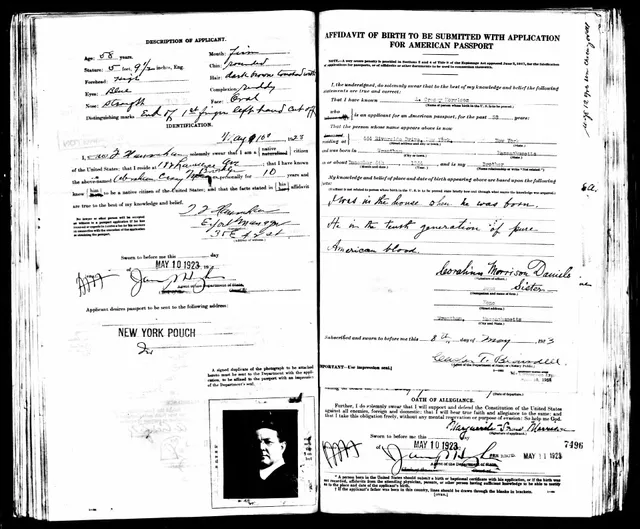
Citizenship is a legal status. It is conferred, inherited, applied for, renounced, revoked, and sometimes held in plural. It has a start date and can have an end date.
Nationality is the ambiguous one. In legal drafting it usually means citizenship. In ordinary speech, and in a great deal of older scholarship, it means membership of a national or ethnic community that may have no state at all. A person can belong to a nation with no country and hold the citizenship of a country whose national identity they do not share. Both statements can be recorded, but not in the same column.
Residence is where someone actually lived, which is often the most informative field and the one least likely to be recorded.
Citizenship at birth cannot be inferred from a birthplace
States assign citizenship at birth on two broad principles: by place of birth, and by descent from a parent. Most states use some blend, the blend has been amended repeatedly, and amendments have sometimes applied retroactively to people already born.
So the citizenship a person held at birth is a function of the law in force in that place at that time, plus their parents' status. In some periods it also turns on their parents' marital status and which parent held what. You cannot derive it from a map.
If a claim about citizenship matters to what you are writing, find the nationality statute of that state for that period, or a legal history that cites it, and record what you found. If you cannot find it, write that the citizenship is not established rather than assuming the obvious answer.
The same caution applies at the other end. Naturalization, loss of citizenship on marriage under older laws, statelessness after a state ceased to exist, and posthumous or symbolic grants of citizenship all put a date on a status that databases usually store without one.
What the catalogs actually store
It is worth being precise about the sources most often cited for this, because they are narrower than they look.
National library name authority records exist to disambiguate names for cataloging, and the same authority control practice runs through museum and archive vocabularies. A record establishes one authorized form of a name, lists variant forms, and often adds dates and a fuller form of the name. It is a control device for finding books, not a biography. Its purpose is met if two people who share a name can be told apart.
The Virtual International Authority File clusters authority records from many national libraries so that the same person's records in different countries link together. The clustering is largely automated. Two clusters can describe one person; one cluster can absorb two people with similar names and dates. A VIAF identifier is a strong hint, not a proof of identity.
Wikidata is closer to what people want, because it keeps place of birth and country of citizenship as separate properties and allows qualifiers that put start and end dates on a citizenship. That structure is good. The weakness is that any individual statement may carry a solid reference, a reference to another tertiary summary, or no reference at all. Check the statement, not the item.
The general point: the presence of a person in a national catalog is a fact about that country's libraries. It tells you something about collecting and publishing. It does not tell you where the person was from.
Institutions assign countries by their own rules
A large share of the country labels attached to people did not come from a passport or a birth certificate. They came from a body that had to decide who counts as representing where, and wrote a rule.
Sports federations set eligibility by some combination of citizenship, birth, parental or grandparental descent, and a minimum period of residence, and they change those rules. Prize and award bodies restrict entry by nationality, by residence, by place of publication, or by language, and each of those produces a different answer.
National academies, delegations, and funding schemes have their own membership conditions. Publishing and broadcasting quotas define national origin by where a work was produced rather than by where anyone was born.
Two things follow. First, different institutions can correctly record the same person under different countries, because each uses a different test and none claims to describe identity.
Second, a dataset built from award records, team rosters, or membership lists inherits whichever tests those bodies used, and those tests are usually documented somewhere the dataset does not mention.
When you take a country from a source of this kind, record the rule with it: represented a country under a federation's eligibility criteria, or was eligible for a prize restricted to a particular nationality. That is what the record supports.
It is not the same sentence as a statement about where someone is from. Readers will treat it as one unless you write the difference in.
The bias you will mistake for a finding
Count records per country in any large biographical dataset and you will get a ranking. The ranking will look meaningful. It mostly measures:
- which archives were digitized, and when
- which languages the cataloging community works in
- which countries funded a national bibliography, and for how long
- which scripts transliterate cleanly into the dataset's index
- how many decades of continuous institutional record-keeping survived war, fire, and regime change
None of that is a property of the people. A long-running, well-funded national library will outrank a country with an older and larger literary tradition whose records were destroyed or never centrally indexed.
Publishing that ranking as a finding about nations is the single most common error in this subject. It is why this site does not publish country league tables of people.
Recording a country claim so it stays true
| Field | Write down | Fails when |
|---|---|---|
| Place | Settlement and region, in the source's spelling | Only a country is stored, so the record cannot be re-checked |
| Polity | The governing state, with the date it applied | Modern and contemporary conventions are mixed silently |
| Basis | Birth, citizenship, residence, or institutional affiliation | Four different bases share one column |
| Date | When the status began, and when it ended if it did | A status is stored as permanent |
| Source | The record that establishes it, and its own scope | A tertiary summary is treated as the record |
| Confidence | Established, probable, or unresolved | Absence of a value is written as a negative finding |
Living people
Do not state a living person's nationality, citizenship, ancestry, or birthplace on the strength of a database entry, a surname, a place of residence, or a photograph. People describe their own origins in ways no schema captures, legal status changes without announcement, and a confident wrong answer about a living person is both false and insulting.
If the question genuinely has to be addressed, the only usable evidence is what the person has said on the record, or an official document they have made public. Attribute it: report that they described themselves a particular way, and when. That sentence stays true even if the underlying situation changes. A flat assertion does not.
Questions to ask of any country field
- Which of the six meanings is this column using, and does the documentation say so?
- Contemporary polity or modern polity, and is the convention consistent across the whole file?
- Is there a date attached to the status, or is it stored as though it never changed?
- Where did the value come froma primary document, an authority record, or another summary?
- If two sources disagree, is the disagreement recorded, or has one been silently dropped?
- Is anyone in this file alive, and does the entry assert something about them that only they can properly say?
Bottom line
A country field compresses a claim about geography, law, and time into one word, so decompress it before use: what basis, what date, what polity, what source.
Related material on this site is organized by heritage, by period, and by work, and the same discipline applies to all three. The country looks easiest and is not.
Common questions
Which convention should a country field use, contemporary or modern?
Either, provided the dataset uses one of them everywhere and records which. The damage is done by switching, which happens invisibly whenever sources are merged.
Is a name authority record evidence of nationality?
No. It is a cataloging device for telling two similarly named people apart, and any place in it usually comes from a title page rather than from research.
How should a disputed or unrecognized entity be stored?
As the entity the record names, with a note on its status and the date. Silently mapping it to a recognized neighbor changes what the record said.
What belongs in the field when a person held more than one citizenship?
All of them, each with its date and its document. A single value forces a choice the sources did not make.
In this guide
- People by country rankings 2027: why none can be builtNo people by country rankings 2027 exist and none can be built: birth, citizenship, working life and family origin point to four different countries.