Guides
Part of People by profession: signal versus noise
People by profession timeline: six institutional layers, each with its own gaps
A people by profession timeline follows institutions: guild, fiscal, directory, union, licensing and employer layers, and who each one leaves out.
Work has been documented for a long time, but not continuously and not for everyone. Which occupations are visible in a given century depends on which institutions were writing things down, and that changed in a small number of large steps.
This guide follows those steps: what kind of body was recording work in each layer, what its records contain, and who they leave out.
What to take away
- Occupational evidence follows institutions, so the record starts where an institution had a reason to keep one.
- Each layer covers a different slice of the working population, and the slices do not add up to everyone.
- Later layers are more complete and more standardized, which makes them look more comparable than they are.
- Absence from a layer is a fact about the layer.

The layers
| Layer | Recording body | What survives | Who is missing |
|---|---|---|---|
| Corporate trades | Guilds and town corporations | Admissions, training agreements, freedoms | Anyone outside the corporation |
| Church and university | Religious and academic institutions | Ordinations, degrees, appointments | Everyone not qualified through them |
| Fiscal and manorial | Tax and estate administration | Liability lists naming a trade in passing | The exempt and the landless |
| Commercial listing | Directory publishers | Trade listings by town and year | Those not canvassed or not paying |
| Association | Unions and mutual societies | Membership and benefit records | Non-members, and whole excluded trades |
| State regulation | Licensing authorities | Registers of the permitted | Practitioners before the regime began |
| Employer | Firms and public bodies | Personnel and pension files | Anyone whose employer's archive is gone |
What each layer is actually for
Corporate records exist to control entry to a trade in a town, which is why apprenticeship agreements name parties, terms, and dates so precisely: they were enforceable contracts. Their coverage is narrow by design.
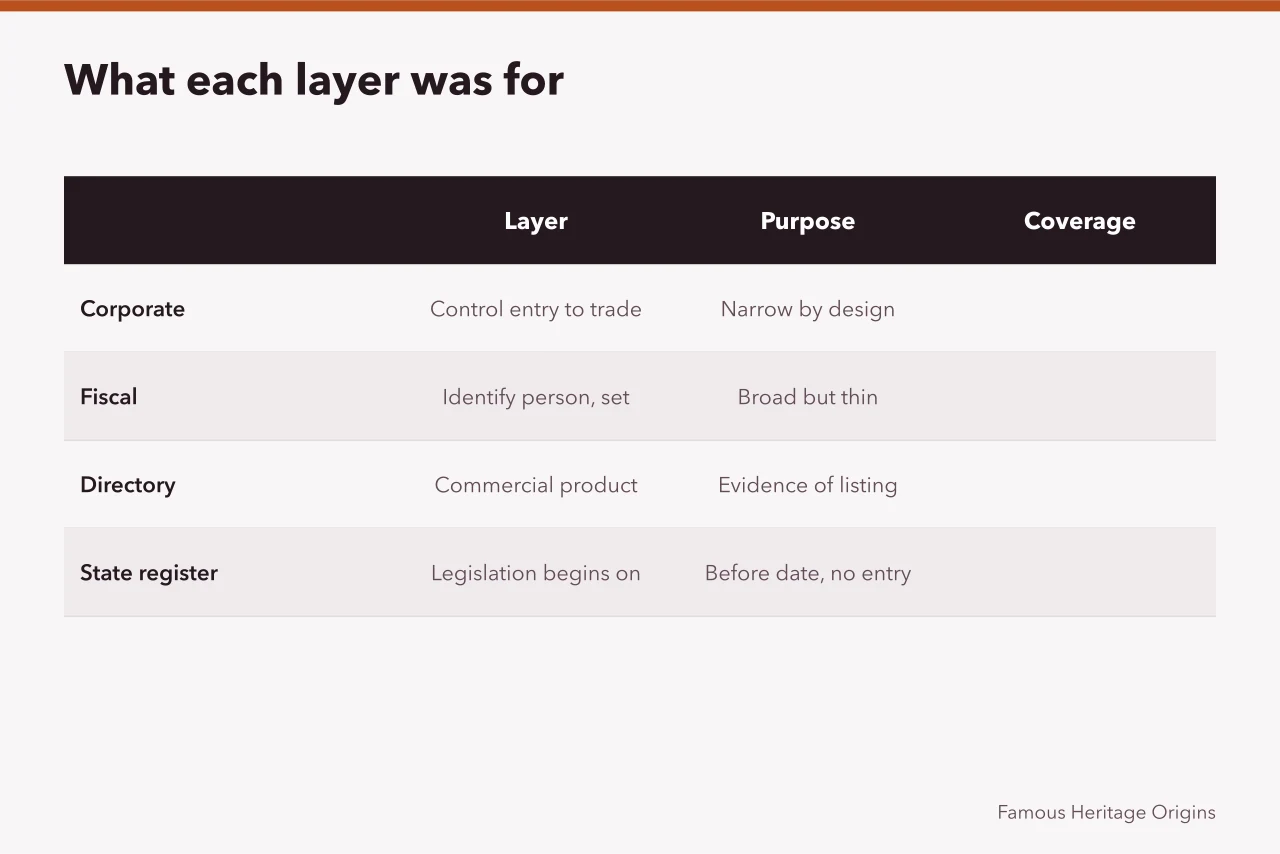
Fiscal records name a trade only because it helped identify a person or set a liability. That makes them broad in population and thin in detail, and it means a trade word in a tax list was chosen by an assessor.
Directories are commercial products. Inclusion depended on being found by a canvasser or on paying, so a directory is evidence of a listing rather than of a practice.
State registers begin on a date, and that date is a fact about legislation. Before it the same work was done by people who left no register entry, which is the single most common misreading of a licensing series.
Standardization arrives late and flatters itself
The most recent layers use controlled vocabularies and consistent forms, which makes them easy to count and easy to overtrust. A standardized occupation field still records what someone said, or what a clerk chose from a list, and the list was written for administrative purposes rather than descriptive ones.
Comparing a standardized modern series with an earlier layer compares a designed instrument with an accidental one. Keep them in separate strands and state which strand each figure came from.
National agencies describe the purpose and coverage of the series they hold, including notes on census records. That description tells you whether the two strands can be compared at all.
Reading absence
Someone missing from a layer is missing from an institution's records, which is a different claim from not having done the work. Unwaged work, informal work, work in trades with no controlling body, and work done by people the body excluded are all systematically absent, and the absences are patterned rather than random.
Write absence as a statement about the search: which layer, which years, which index. That is the only version of the sentence that stays true.
Out of scope
This timeline documents work, not people's backgrounds. Occupational patterns in a record set are not used here to infer anyone's origin or community, and the reasoning is on the heritage pillar. Ranked versions of the same idea are covered on the fame rankings pillar.
For classification and title handling, see the profession pillar; for how the layers differ between jurisdictions, the country pillar.
Common questions
Which layer is best for finding an ordinary working life?
Usually fiscal and directory records, because they cover more people, even though each entry is thin. Regulated registers are richer per entry and much narrower.
Do these layers exist everywhere?
The types recur widely; the dates and survival vary enormously. Check the holding archive's description for the specific place before assuming a layer exists.
How do I compare an early and a late layer?
Usually you do not. Describe each separately. If a comparison is unavoidable, restrict it to a population and period both layers actually cover, and say so.
What if two layers disagree about someone's trade?
Both can be right. People changed work, held more than one trade, and were described differently by different recorders for different purposes.