Costs
Part of People by profession: signal versus noise
Straight talk on people by profession directory
A people by profession directory needs a synonym layer: historical and regional title variants, definitions for obsolete trades, and notes on splits.
An occupation index has one problem a period index does not: the words. Trades were renamed, split, merged, and abandoned, and a reader searching for a modern term will miss everything filed under the term that was current at the time.
This page is about building the synonym layer that makes such an index usable, and about handling occupations that no longer exist.
What to take away
- A browse label and a search term are different objects, and the index needs both.
- Obsolete trade names need a definition on the page, because a reader who searches for one is already lost.
- Splits and merges in an occupation break a category's history, and the index should say where.
- An occupation page that lists people is a page about a record set, so it needs a scope note.
The three layers of an occupation index
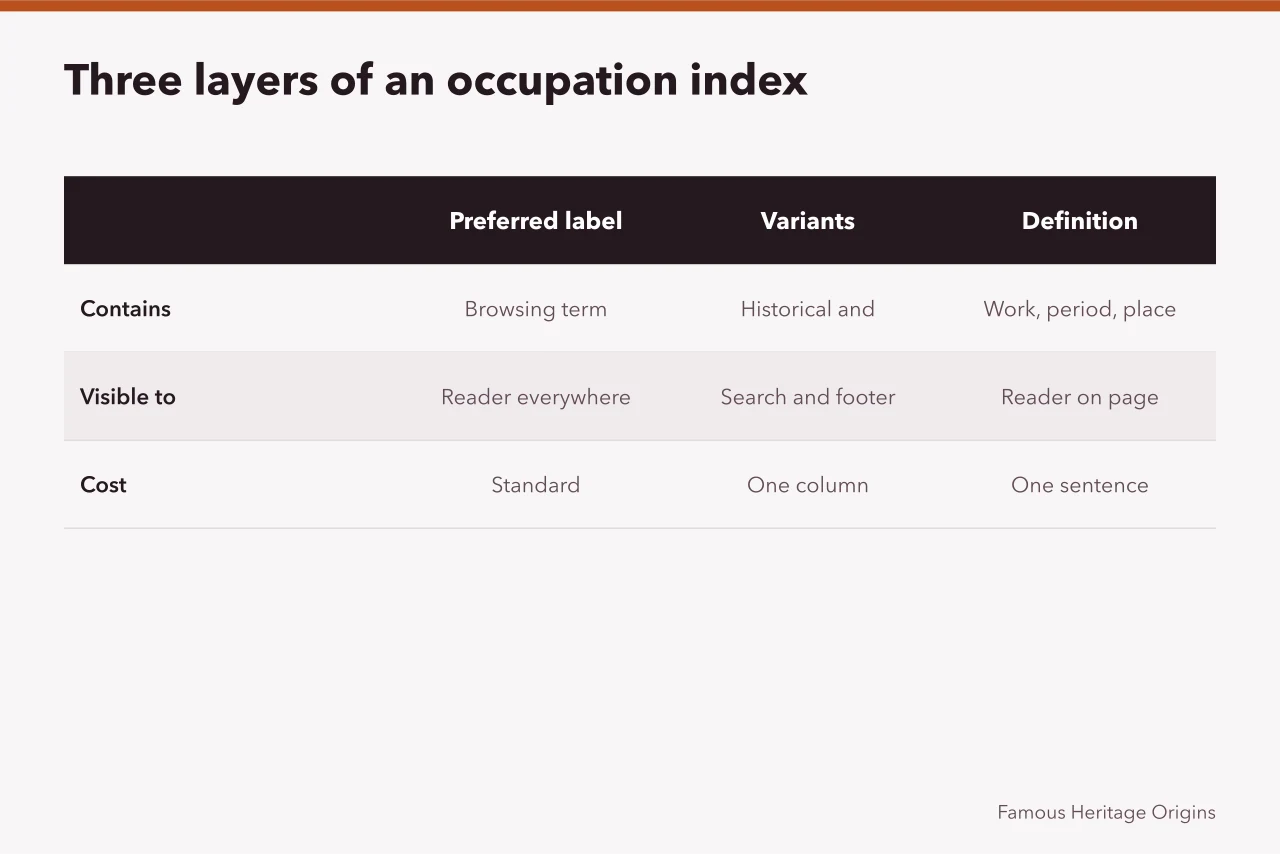
| Layer | Contains | Visible to |
|---|---|---|
| Preferred label | The term the index browses under | The reader, everywhere |
| Variants | Historical, regional, and spelling forms | The search, and the page footer |
| Definition | What the work was, in that period and place | The reader, on the page |
Most published occupation indexes have the first layer and nothing else. The second is what makes them findable, and it costs one column.
Where variants come from
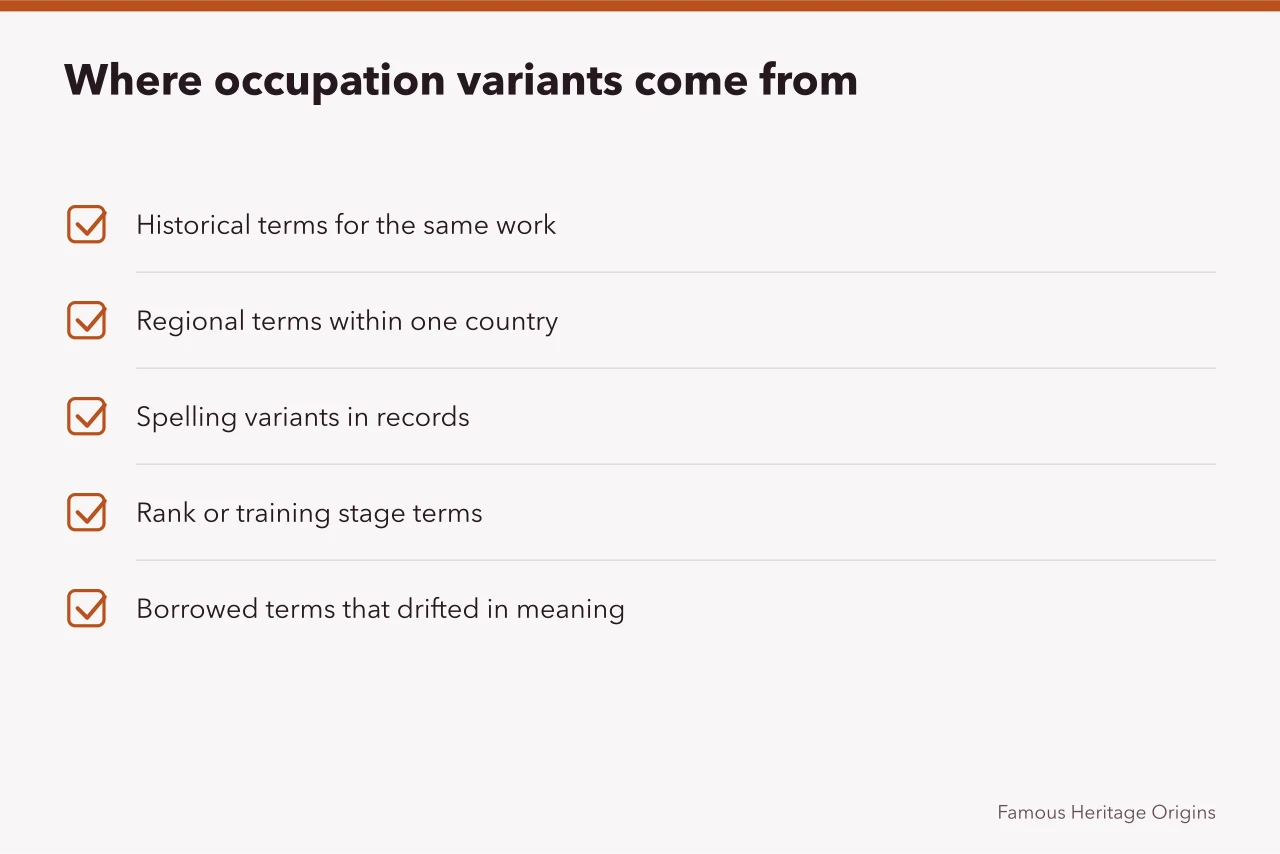
- Historical terms for the same work, sometimes several per century.
- Regional terms, which differ within a single country.
- Spelling variants in records, including phonetic renderings by a clerk.
- Terms that name a rank or a stage of training rather than the trade.
- Terms borrowed from another language and then drifting in meaning.
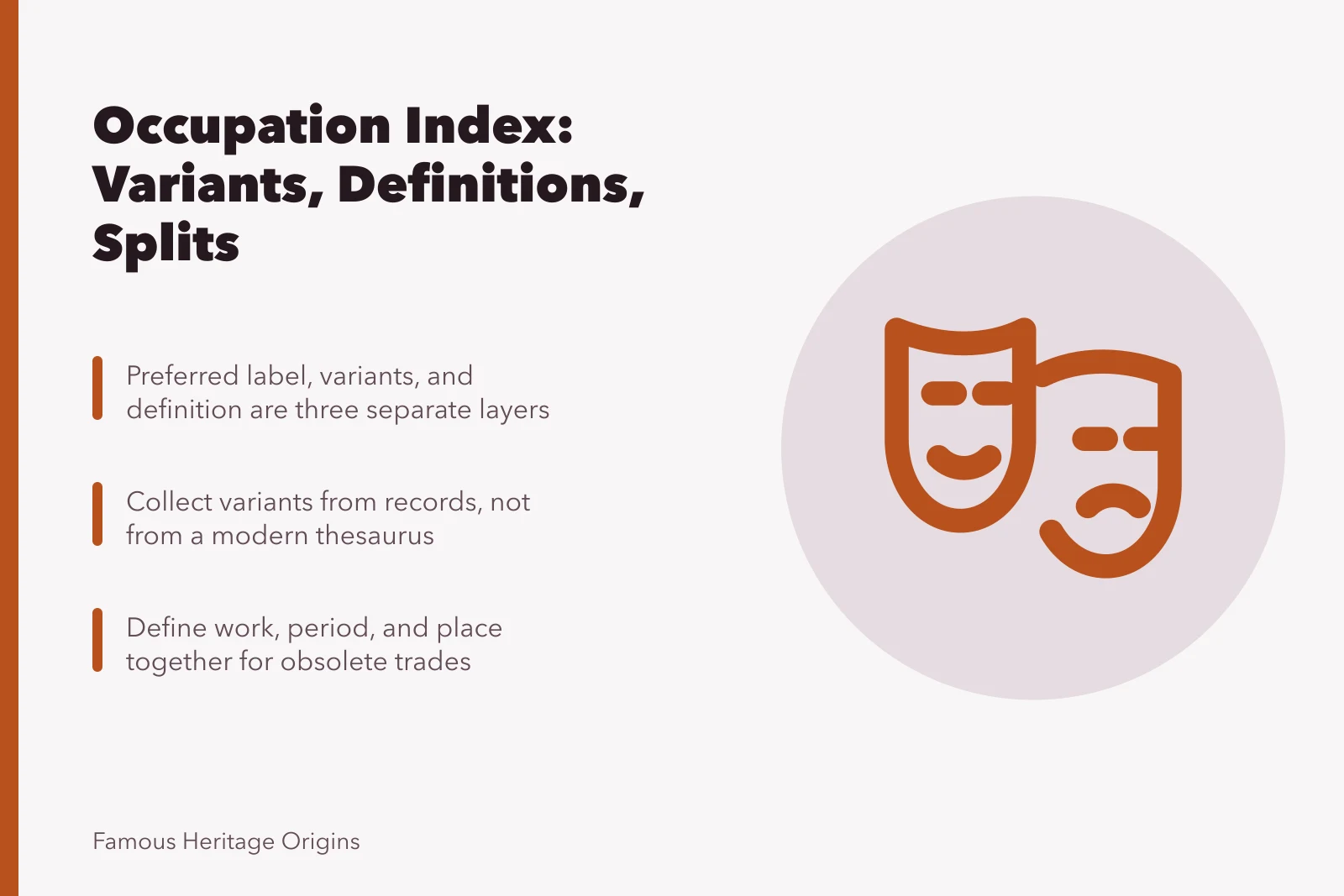
Collect variants from the records themselves rather than from a modern thesaurus. The forms that matter are the ones that actually appear in the series you index, and those are usually not the forms a modern reference work lists.
Obsolete occupations
An obsolete trade name is the case where an index earns its keep. The reader has met the word in a record and wants to know what it was, so the page should answer in a sentence before it does anything else.
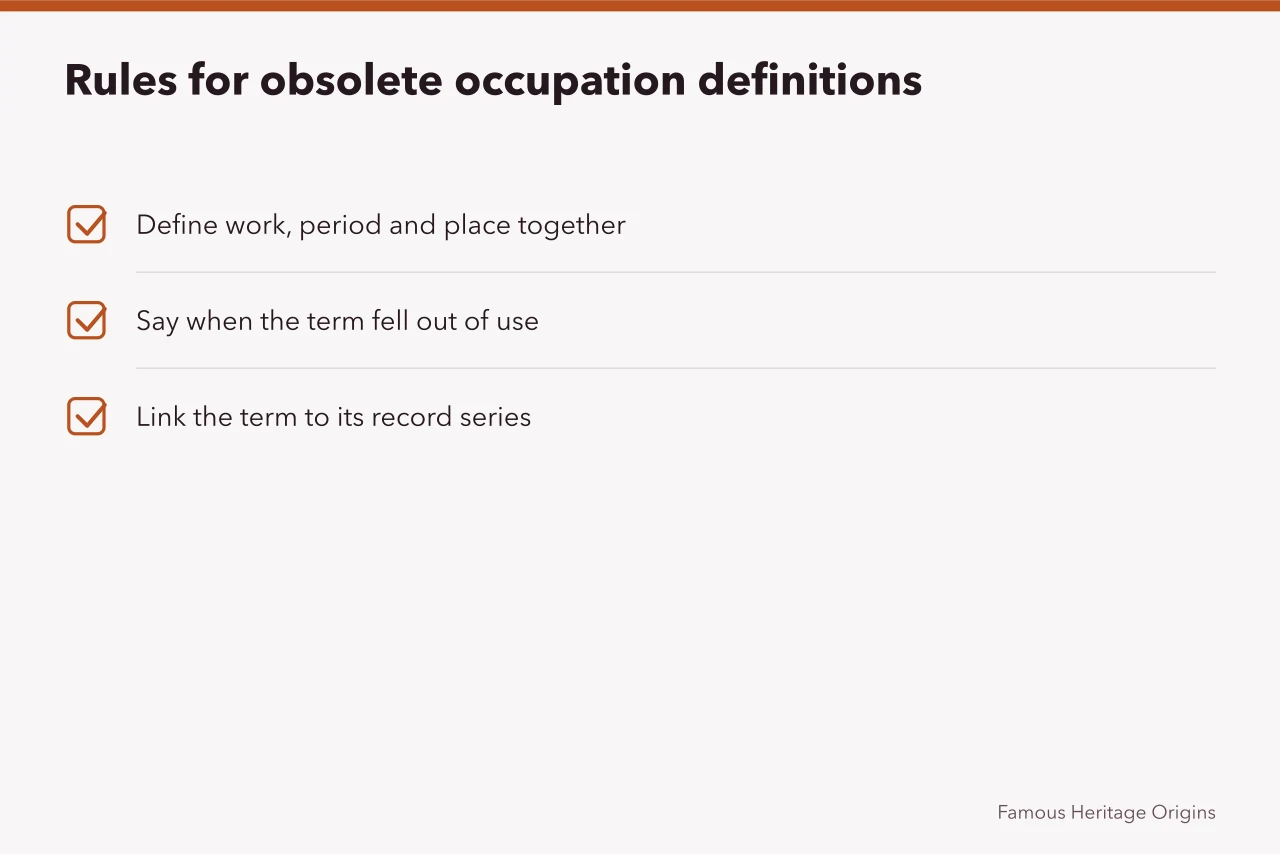
Three rules for those definitions:
- Define the work, the period, and the place together, because the same word covered different work elsewhere.
- Say when the term fell out of use, if a source supports it, and otherwise say that it is unclear.
- Link the term to the record series that document it, rather than to a list of people. The series is what the reader needs next.
Training relationships often supply the best evidence for what a defunct trade involved, since apprenticeship records describe the work being taught and the terms of entry.
Splits, merges and dead categories
Occupations do not persist unchanged. One trade divides into two specialisms; two merge under a new name; a whole category disappears when its technology does.
An index should mark these, because a count that runs across a split is a count of two different things. A short note on the page, saying what the category became and when, prevents the most common misreading of any occupation series. A people by century directory states its bucketing rule for exactly this reason, so a count never crosses a boundary it cannot defend.
The scope note
Any page listing people under an occupation is a page about which records were searched. It needs a paragraph saying which series, which places, which years, and which index. Without it the page is read as the set of people who did that work, which no source can support. The way national agencies scope their own occupational and employment series, described across their genealogy research pages, is the model to copy.
What the index will not do
It does not group or subdivide occupations by the origin, community, or nationality of the people in them. Occupational concentration in a record set is a fact about recording and about entry rules, not about groups, and the reasoning against publishing it that way is on the heritage pillar. Ranked forms of the same idea are covered on the fame rankings pillar.
For the classification questions behind the labels, see the profession pillar; for period handling, the century pillar.
Common questions
Should the browse label be the modern term or the historical one?
The modern term, with the historical ones as variants that resolve to it, plus a definition explaining the difference. Readers arrive with modern words.
How many variants is enough?
However many appear in your sources. This is not a vocabulary exercise: collect from the records, and add more as you meet them.
What about a trade that existed only in one region?
Give it its own entry rather than folding it into a near neighbor. Folding it loses the regional specificity that made it worth indexing.
Can two occupations share a page?
Only if the sources treat them as one, and then say so. Merging them for convenience creates a category no record ever used.